LEARNING OBJECTIVES
Objectives of communication are:
4.1 INTRODUCTION
Communication is an exchange of facts, ideas, opinions, and emotions by two or more persons. Communication transmits information not only about tangible facts and determinable ideas and opinions but also about emotions when a communicator passes on or transmits sound information, he may also intentionally or unconsciously be communicating his attitude or the frame of his mind. When we are communicating or interacting with anyone then it may be face- to-face or face-off, formal or informal, oral or written or digital or even with the help of visuals.
As studied earlier there are few essential elements of communication like sender, receiver, message and medium, and on the basis of mainly nature of message and medium of communication may be categorized into different categories like:
Three Modes of Communication:
On the basis of way of delivery of the message communication may be denoted through three modes:
Transfer of information is possible in two ways either by using language or with the help of body movement. It can be verbal and non-verbal communication.
Verbal Communication: It encompasses both how you deliver messages and how you receive them. Communication is a soft skill, and it’s one that is important to everyone whether student or teacher, employee or employer, or any sender and receiver. One who can convey information clearly and effectively are highly valued and are also highly benefited in every field of life. What constitutes effective verbal communication depends on the relationships between communication partners and the work context. Verbal communication in a work setting takes place between many different individuals and groups such as co-workers, bosses and subordinates, employees, customers, clients, teachers and students, and speakers and their audiences. Verbal communication occurs in many different contexts including training sessions, presentations, group meetings, performance appraisals, one-on-one discussions, interviews, disciplinary sessions, sales pitches and consulting engagements.
Non-verbal Communication: When you’re interviewing for a job, your body language is almost as important as the answers you give to the questions. Employers will evaluate what you do as well as what you say, and you can use your non-verbal communication skills to make the best impression. Most candidates carefully prepare what they will say during interviews and networking meetings. Less attention is typically paid to how messages are communicated. Your interviewing and networking success will be largely determined by how the people you meet respond to what you are saying. Your non-verbal communications can either support the tone of your conversation or leave the interviewer wondering whether you’re all talk and no substance. Displaying non-verbal behaviours that are a match for your messages can help you to convince employers that you are genuinely interested in the job and suited for the work. In general, what’s most important is to be positive and engaging. If you feel confident about your ability to do the job and know you’ll be an asset to the employer, you can show that by your actions as well as your words. In addition to making a hiring decision, employers will also be evaluating your non-verbal skills to determine whether you will be able to relate effectively to clients, co-workers and business associates. In many occupations, the ability to establish credibility and trust is a significant success factor. Positive non-verbal behaviour will enable you to demonstrate your sincerity and engaging personality.
4.2 FACE-TO-FACE COMMUNICATION
Face-to-face interaction is a concept in communication studies describing social interaction carried out without any mediating technology. Face-to-face interaction is defined as the mutual influence of individuals’ direct physical presence with his/her body language. Face-to-face interaction is one of the basic elements of the social system, forming a significant part of individual socialization and experience gaining throughout one's lifetime. Similarly it is also central to the development of various groups and organizations composed of those individuals.
Study of face-to-face interaction is defined as the process of recording and analyzing the reactive pattern of individuals when they are involved in a face-to-face interaction. It is concerned with issues such as its organization, rules, and strategy. The concept of face-to-face interaction has been of interest to scholars since at least the early 20th century. One of the earliest social science scholars to analyze this type of interaction was sociologist Georg Simmel, who in his 1908 book observed that sensory organs play an important role in interaction, discussing examples of human behaviour such as an eye contact.
Face-to-face communication has been however described as less preferable to mediated communication in some situations, particularly where time and geographical distance are an issue. For example, in maintaining a long-distance friendship, face-to-face communication was only the fourth most common way of maintaining ties, after telephone, email, and instant messaging.
Despite the advent of many new information and communication technologies, face-to-face interaction is still widespread and popular and has a better performance in many different areas where face-to-face communication is described as the most efficient and informational one. This is explained because face-to-face communication engages more human senses than mediated communication. Face-to-face interaction is also a useful way for people when they want to win over others based on verbal communication, or when they try to settle disagreements. Besides, it does help a lot for teachers as one effective teaching method. It is also easier to keep a stronger and more active political connection with others by face-to-face interaction.
Face-to-face communication offers more scope to motivate team members than electronic communication. It also allows you to get a clear picture of how well your message has been understood and whether the team member has any reservations about what they are being asked to do. Face-to-face communication is particularly suitable for discussion as there is immediate feedback from the listener. It is particularly effective when the work under discussion requires coordination and collaboration. One of the biggest advantages of face-to-face communication is that it can create a bond of trust between people in a way that electronic communication simply cannot.
Face-to-face communication may be defined as communication when the communicator transmits his message in person to the receiver in person verbally and even non-verbally. Thus face-to-face communication is both verbal and non-verbal. All face communication is oral, but all oral communication need not to be face-to-face, for example, the telephonic talk is oral but not face-to-face. The types of face-to-face communication are as follows: Interviews, Meetings, Conferences, Seminars, Workshops, Class-room lectures, Stage-acting, Public lectures, etc.
Principles/Dynamics of Effective Face-To-Face Communication:
The Advantages of Face-to-face Communication
In this modern age of technologically-driven business, it can be easy to push aside actual, physical human interaction for communication via electronic device. We email, we IM, we use social media, we text, we talk on the phone, but we often forget that all of these are missing one common component – real, face-to-face, human interaction. Therefore, the question must be asked… does it matter? Does face-to-face time with your team really make a difference to them, or are they more than willing to receive their instructions via email and through phone calls?
This is a great question, and is one that holds a lot of relevancy today. We do live in an age of electronic communication, and it does help us in a lot of ways… but has it gone too far? Are many employees feeling disconnected due to a lack human interaction, and is it having detrimental effects on their productivity? To be honest, the answer is different for everyone. There might be people out there who don’t mind not speaking face-to-face as often, though the largest percentage of people would benefit from more actual, tangible human interaction… especially where their management is concerned. Now it is discussed ‘what are the advantages of face-to-face communication over communication via electronic devices?’
Face-to-face Communication Creates More Motivation: There is no denying the fact that speaking to someone in person can make it much easier to motivate them. Of course, you could write a long-winded message to your employees telling them how much they do for the company, but is this going to be more effective than walking up to them, smiling at them, and thanking them in person for their hard work? While you can definitely contribute to motivating your team through electronic communication, there is no doubt that face-to-face interaction has a special relevance in this area. Face-to-face communication also helps to build collaborative environments that inspire and energize employees to participate in meetings, brainstorming sessions and more. These environments foster engagement and innovation, which is important for employee satisfaction as well as company culture and growth.
Face-to-face Communication Makes it Easier to Sense What a Person is Really Thinking: While it might be possible to ‘read’ a person based on the language in their emails, there is no greater way to gauge what an individual is thinking than to speak to them in person. Did you know that spoken words account for less than 10% of the communication between humans? The rest consists of body language, voice inflection, facial cues etc. Therefore, it stands to reason that, in order to really communicate with someone on a level that will allow you to ‘read’ the subtleties in their communication that are not made up of actual words, making sure that there is at least a healthy amount of face-to-face interaction would definitely be a positive thing. Non-verbal cues are just as crucial when communicating as the words we say. Everything from body language and facial expressions to attentiveness and engagement can indicate different thoughts and feelings – each of which can only truly be observed through face-to-face communication.
Face-to-face Communication Creates a Bond: Whether you want to call it friendship, a partnership, camaraderie, or simply a good working relationship, developing a real bond with someone is far more difficult if you do not ever get to speak to them face-to-face. When it comes to your team, you are likely going to need to develop at least a decent amount of trust for each other… so why forgo face-to-face interaction when it could serve to better strengthen the bonds of trust between two people who are going to be relying on each other and working together? Of course, you don’t need to be friends with everyone that you work for, but friendship can happen in the workplace, and avoiding face-to-face interaction may definitely impede this natural process from running its course. A sense of community comes with the ability to interact and socialize, and this sets the foundation for trust, and ultimately better working relationships.
Addressing Sensitive Issues: When addressing sensitive issues, put down the phone, move away from the keyboard, and make the effort to engage in-person – it will be crucial to a successful outcome. Whether you are providing specific feedback to a staff member or addressing an issue with a colleague, much can be misinterpreted or lost when communicating via technology. Focus on your desired outcome and prepare by considering the mindset and possible reactions of the one you will be communicating with. This can help to turn a challenging conversation into a trust-building interaction.
Clear and Concise Communication: How many times has an email been misunderstood, misread or perceived by another party to be rude when that wasn’t the intention? Face-to-face conversations minimize the risk of miscommunication, promoting more effective business practices. Sometimes encouraging face-to-face interactions can be as simple as persuading others to walk down the corridor rather than sending an email. The importance of real conversations, in real time and real rooms, should never be underestimated.
Today’s technology makes communication faster and easier than ever before. But it shouldn’t be the only way we communicate. And for all our innovation, nothing can quite replace the impact of face-to-face communication.
Types of Communication:
Communication is an exchange of facts, ideas, opinions, and emotions by two or more persons. Communication transmits information not only about tangible facts and determinable ideas and opinions but also about emotions. When a communicator passes on or transmits sound information, he may also intentionally or unconsciously be communicating his attitude or the frame of his mind. Transfer of information is possible in two ways either by using language or with the help of body movement. Thus, communication can be divided into two classes – verbal and non-verbal.
Verbal Communication is when we communicate our massage verbally. It requires the use of words, vocabulary and symbols. We transfer information which may be factual or specific. It may also convey emotions, attitudes, beliefs, desires etc. A symbol is essentially a sign to which some meaning is assigned by convention rather than by any external similarity between the sign and its denotation. Thus, for example, a word like lion is a symbol: the word does not resemble a lion.
Non-verbal Communication: When we use language of signs, symbols and gestures rather than that of words for communicating or interacting with others it is known as non-verbal communication. The main elements of the non-verbal communication are personal appearance, postures, gestures with different parts of the body, facial expressions, eye contact, the distance between the speaker and the listener, the tone of the speaker, the volume of the speaker, the pauses taken between words and sentences, the emotional content of the communication. All non-verbal cues help the communicator to talk without words. These cues are used to express love, respect, likes, dislikes, dependence, feelings etc. Non-verbal cues give us the following information:
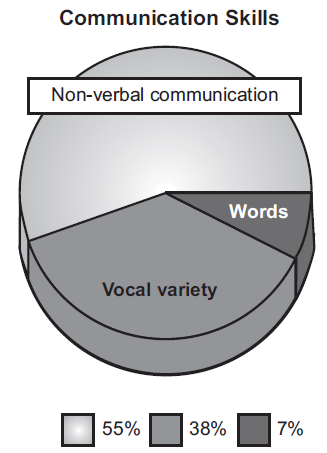
To make communication effective statistics show that words play only a 7% role, tone of the voice 38% and non-verbal cues play a role of the remaining 55%, show how material is more important that what is said.
Fig. 4.1: Communication Skills
Verbal communication:
When two people interact by using language, it is known as verbal communication. If we are using oral mode of language for transferring information it is known as oral communication. If we use written mode of language for transferring information, it is known as written communication.
Oral Communication:
It implies the conveying of message through spoken words. It is face-to-face communication between the individuals and also includes communication through telephone, intercom, public speech etc. The important feature of oral communication is that the real meaning is conveyed by the manner or tone of the voice or facial expression of the communicator and the communicatee. There are many methods of oral communication: dyadic communication, telephonic conversation, interview, dictation, meeting, interviewing, lectures, announcements, radio talks, TV and cinema shows, seminars and conferences, group discussions, use of audio visual aids, and negotiations.
Categories of Oral Communication
Merits of Oral Communication
Demerits of Oral Communication
Written Communication:
Written communication implies transmission of messages in black and white. Everything that is transmitted in the written form falls in the area of written communication. It includes circulars, reports, magazines, manuals, newspapers letters, applications, tenders, memos, notices, telegrams, e-mails, pictures, diagrams, graphs, agreements, rule and procedure books, orders, instructions, questionnaires etc.
Merits of Written Communication
Demerits of Written Communication
4.3 NON-VERBAL COMMUNICATION
Non-verbal language gives us the cues for interpreting human behaviour, for transmitting messages and clues about intentions, emotions, views, personality and social status of the people. In this communication we are concerned with things like body language, postures, gestures, space, tone, voice system. While on a job interview, you might think that if you have the best answers to the interview questions, you'll get the job. In fact, that isn't necessarily the case. A big part of the success of your answers is actually non-verbal communication. This includes your body language and what is known as “paralanguage” – the elements of your speech besides the words, such as your intonation, speaking speed, pauses and sighs, and facial expressions. Non-verbal communication also includes your attire and grooming. Non-verbal communication is as important, or even more important than, verbal communication. The interviewer will be observing your non-verbal communication throughout the entire interview. If your non-verbal communication skills aren't up to par, it won't matter how well you answer the questions.
Non-verbal communication matters as soon as you walk in the office door. If you come to an interview reeking of chewing gum, you will already have one strike against you. Too much perfume or not enough deodorant won't help either. Not being dressed appropriately or having scuffed shoes will give you a second strike. Talking on your cell phone or listening to music while waiting to be called for the interview may be your final strike.
What's important when interviewing is to appear professional, attentive, and confident throughout the interview process. Before you leave for the interview, make sure you are dressed professionally, are neatly groomed, your shoes are polished, and you haven't overdone the perfume or aftershave (none is better than too much).
There are things that you should bring with you to the interview and things that you need to leave at home. What to Bring to an Interview: Portfolio or pad holder with a copy of your resume and a list of references on quality paper, Work samples (if relevant), Notepad and pen; and What Not to Bring to an Interview are: Cell phone, iPod, Gum, Candy, Soda or coffee, Scuffed shoes, messy and/or not-so-clean clothes. The way you sit in the lobby, the way you greet the receptionist and the interviewer, and the way you wait, will all have an impact on whether you are going to be considered for the job. Be friendly and pleasant, but not overbearing. If you need to wait, sit quietly (no phone calls) and patiently.
Shake hands with the interviewer. Your handshake should be firm – not sticky or wimpy. To avoid sweaty palms, visit the rest room, wash your hands, and then run them under cool water prior to the interview. Keep your palms open rather than clenched in a fist and keep a tissue in your pocket to (discreetly) wipe them.
Important non-verbal communications during interview are:
We could classify non-verbal communication into four different broad categories: Kinesis or Body language, Proxemics or Personal Space language, Chronemics or time, Paralingual.
Kinesics: Body movement or body language.
Proxemics: Space language.
Chronemics: Time Language.
Paralingual: Actions and words as hints for communication (pitch/voice/manner etc.).
4.4 BODY LANGUAGE OR KINESICS
Kinesis means body language: The communication without words and through various movements of body parts. All the body movements are guided by our thought process, emotions etc. By nodding, blinking and various other ways we send out our signals and messages that often speak louder than words. A body movement consciously or instinctively carries messages, attitudes, moods, feeling and so on. The term body language includes: facial expression, gestures, body movements or postures, eye contact, haptics etc.
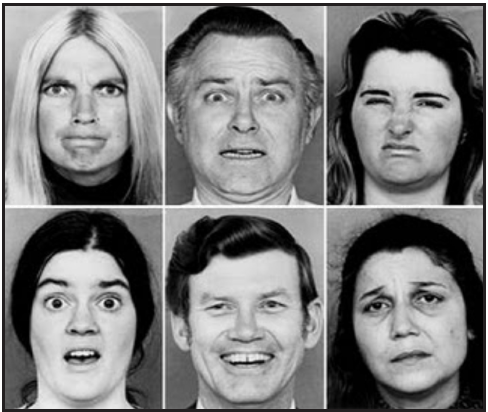
Fig. 4.2: Different Facial Expressions
Four important parts of the human face are: Upper face – forehead and eyebrows; Middle face – the sides of face, cheeks; and Lower face – mouth and chin. These parts of the human face are capable of having a wide range of expressions and emotions.
W. Evary has listed the following possible components of facial expressions:
Difference between Gesture and Posture
A gesture is a form of non-verbal communication in which visible bodily actions communicate particular messages, whereas posture is a stance and/or alignment as compared to a balanced position for the human body. Body language is the non-verbal, usually unconscious, communication through the use of postures, gestures, facial expressions, and the like. A gesture is a form of non-verbal communication in which visible bodily actions communicate particular messages, either in place of speech or together and in parallel with spoken words. Gestures include movement of the hands, face, or other parts of the body. Gestures differ from physical non-verbal communication that does not communicate specific messages, such as purely expressive displays, proxemics, or displays of joint attention. Gestures allow individuals to communicate a variety of feelings and thoughts, from contempt and hostility to approval and affection, often together with body language in addition to words when they speak.
Proxemics or Personal Space Language:
It refers to the non-verbal study of space and distance we use to communicate a message. The concept of territorial space refers to the area around the self that a person will not allow another person to enter without consent. Human relationships can be characterized as intimate, personal, social and public. The way people communicate with one another depends upon the proxemics where the people are in relation to one another. How we interact with our physical space can communicate a lot to other people. Are we friendly? Are we mean? Are we possibly insane? One of the basic ideas in communication is immediacy, or the ways that we communicate openness, friendliness, and a desire or willingness to communicate with others. Just think about it, how do you signal to someone that you are interested in communicating?
Common non-verbal signals of immediacy include things like smiling and waving, but this also extends to your use of physical space. Again imagine two people in a room together, one with his back to the other, leaning against a wall with his arms crossed. The other is taking up more physical space, displaying an openness and trustfulness. Which of these people is showing more immediacy? The one taking up more physical space is communicating immediacy. Immediacy is what we use when we want to display openness. But, sometimes we want to communicate something else, like what's ours. Territoriality is the non-verbal communication of ownership. When you feel protective of a specific physical space or item, your body language reflects that.
Again imagine two figures of people using non-verbal cues to denote ownership. The first person is sitting on a couch, but is stretched out all across it, taking up as much space as possible. If that person was interested in sharing this space, he'd be sitting on it differently. Figure two is sitting at a table, and is demonstrating her territoriality by filling up the space on the table with her papers, books, and coffee. Again, the message is clear: 'I'm using this space, don't touch.'
Most of our interaction with the world around us is defined by personal space, the immediate area around a person through which they feel ownership and safety. Our personal space is very important to us. Think of this as your personal bubble. You don't like just anybody coming inside your bubble; this can make you feel insecure, possible unsafe, and generally irritable.
We expect people to respect our personal space, and when they don't, we can react with hostility. This is called expectations violation theory. Basically, the idea is that we have expectations about personal space that are generally cultural, and we will use non-verbal communication to express discomfort or dissatisfaction when those expectations aren't met. For many people, this is one of the major areas of culture shock when travelling, since different cultures have very different ideas about personal space.
In order to prevent this from happening, most of us try to non-verbally communicate the extent of our bubbles to everyone around us. We call the creation of a protective buffer zone around a person the body buffer zone. Basically, this is another way to describe the personal bubble. You create a buffer zone, the limits of your personal space, and when people move into it, you find ways to communicate discomfort. The further into the buffer zone they get, the less subtle those signs are.
Proxemics is another notable area in the non-verbal world of body language and is related to spatial relationships. Introduced by Edward T. Hall in 1966, proxemics is the study of measurable distances between people as they interact with one another. Hall also came up with four distinct zones in which most men operate. According to this buffer zone or proxemics, the distance zones may be:
In addition to physical distance, the level of intimacy between conversants can be determined by "socio-petal socio-fugal axis", or the "angle formed by the axis of the conversants' shoulders". Changing the distance between two people can convey a desire for intimacy, declare a lack of interest, or increase/decrease domination. It can also influence the body language that is used. For example, when people talk they like to face each other. If forced to sit side by side, their body language will try to compensate for this lack of eye-to-eye contact by leaning in shoulder-to-shoulder.
It is important to note that as with other types of body language, proximity range varies with culture. Hall suggested that "physical contact between two people ... can be perfectly correct in one culture, and absolutely taboo in another". In Latin America, people who may be complete strangers may engage in very close contact. They often greet one another by kissing on the cheeks. North Americans, on the other hand, prefer to shake hands. While they have made some physical contact with the shaking of the hand, they still maintain a certain amount of physical space between the other persons. In India we try to avoid any kind of close proximity with strangers.
Chronemics:
It involves the meaning given to time dimension when we are communicating to someone. Delay in replying to a personal or business letter or a phone call, coming late for work or meetings are example of chronemics. In non-verbal communication completion of task within a specific time span is recommended; it communicates hard work, sincerity, and loyalty.
Paralanguage:
It involves the ‘how’ of the sender’s voice or the manner in which he speaks. Paralanguage (sometimes called vocalics) is the study of non-verbal cues of the voice. Various acoustic properties of speech such as tone, pitch and accent, can all give off non-verbal cues. Paralanguage may change the meaning of words. Different elements of paralanguage are pitch variation, speaking speed, volume variation, tone variation, pauses between words and sentences, proper words’ stress, the clearness of the voice etc.
In the first sentence the speaker is requesting to get his book. In sentence 2, the speaker wants his book back. In sentence 3, the speaker wants to get his book back (and it should be given to him only not to anybody else). In sentence 4 the speaker wants to get back his own book (not of anybody else). In sentence 5, the speaker wants to get back his book (not anything else).
Key Points Regarding Body Language:
Body language or non-verbal signals tell us about the person’s attitude, outlook, interests, and approach. They speak louder than the verbal communication during the interview or any type of interaction. “The most important thing in communication is hearing what isn't said.”
– Peter F. Drucker
The non-verbal communication helps to confidently assess each candidate’s credentials with regard to the skills necessary to do the job, behavioural characteristics you have identified as necessary for success in the job, and culture and environment of the organization.
These are examples of non-verbal communication you need to pay attention to and “hear.”
Listening to the non-verbal communication of your candidates can tell you as much about the candidates as their spoken words, their references, and their experience. Non-verbal communication matters.
4.5 TONE OF VOICE
Tone, in linguistics, is a variation in the pitch of the voice while speaking. Tone is the attitude or how somebody sounds whereas intonation is the rise and fall of voice, sound or tone. Tone is shown or heard in how something is being said. It is more like an attitude rather than being a voice pattern. It is somebody’s general sound; he may sound happy, upset, excited, angry or ecstatic among other moods. Thus, tone is part of pragmatic communication. This means that emotion has a great deal of influence to one’s tone. By using different tones, the words in a sentence can have other meanings aside from the real original meaning of those words.
Tone of voice is the quality of a person's voice. Tone of voice shows manner of speaking, delivery and speech – or we can say it is your characteristic style or manner of expressing yourself orally. A tone of voice also shows what the speaker is feeling; for example; there was a note of uncertainty in his voice; he spoke in a nervous tone of voice; there is a musky roundness to his wordiness; he spoke in undertones etc. One can adjust one’s tone by fluctuating the pitch. When your pitch increases in a particular manner it's called rising intonation. When your pitch decreases in a particular manner it's called falling intonation.
A study by Dr. Mehrabian investigated the impact when words and other communication were not consistent. Findings showed that only 7% of the message people received was dependent on the words you use. 38% reflected tone of voice and 55% facial expression or body language. It’s important to know how your tone and appearance affect how people perceive your message. Their perception is reality. As we know the tone of voice we use is responsible for about 35-40 percent of the message we are sending. Tone involves the volume you use, the level and type of emotion that you communicate and the emphasis that you place on the words that you choose.
Tone of Voice in Speaking / Speech:
To see how this works, try saying the sentences below with the emphasis each time on the word in bold –
I didn’t say he borrowed my book.
I didn’t say he borrowed my book.
I didn’t say he borrowed my book.
I didn’t say he borrowed my book.
I didn’t say he borrowed my book.
I didn’t say he borrowed my book.
I didn’t say he borrowed my book.
The same sentence can have multiple meanings depending on which word is emphasized. The emphasis on a particular word implies additional information than what the words say. Notice that the meaning of the sentence changes each time, even though the words are the same. The emphasis you place on the word draws the listener’s attention, indicating that the word is important somehow. In this case, the emphasis indicates that the word is an error. So in the first example, I didn’t say he borrowed my book, the phrase includes the message that someone else said it. The implied information continues to change in each sentence, despite the words remaining the same each time.
Tone of Voice in Writing / Literature:
Tone of voice is a combination of spoken language and body language. In literature, the tone of voice refers to the author’s feelings towards the subject, as expressed through the writing itself. Tone is more than just the words we choose. It’s the way in which we communicate our personality. Tone of voice is the way we tell our users how we feel about our message, and it will influence how they’ll feel about our message, too. Despite its name, tone of voice isn’t just about how you speak. It includes all the words you use in your business content, including in your notices, sales emails, product brochures, call-center scripts, and client presentations, to name just a few examples. Oh, and by the way, tone of voice isn’t the same as good writing or strong messaging. It’s the next level up from those things. It’s about using language to give your brand its own distinct and recognizable voice.
All the content you produce should have the same tone of voice. When your tone is consistent, your audience hears the same person speaking whenever and however they deal with you. That shows them you’re a consistent, reliable company to deal with, and that every part of their experience with you will be equally good. The manner in which something is said can affect how it should be interpreted. Shouting, smiling, irony and so on may add a layer of meaning which is neither pure body language nor speech.
Tone of voice isn't what we say but how we say it. It's the language we use, the way we construct sentences, the sound of our words and the personality we communicate. It is to writing what logo, colour and typeface are to branding. Tone of voice is how the character of your business comes through in your words, both written and spoken. It’s not about what you say, but rather the way that you say it, and the impression it makes on everyone who reads or hears you. Think about it. Everyone you meet has their own way of expressing themselves that’s as unique as their face or fingerprint. Some are pleasant and polite. Others are pushy and in your face. Some say so much with just a few words. Others never seem to get to the point. Companies are no different.
The difference between voice, tone and style: Tone, voice, and style as three separate elements, which work together in harmony:
Voice is a description of the unique, distinctive voice of your brand. This should cover its personality: is it playful, cheeky and fun like innocent, or personal, inspiring, straightforward and active like Macmillan; its rhythm and pace: are you short and sharp like Oxfam, or musical like Penhaligons; its vocabulary: plain and simple like Ovo, or rich and poetic like Dom Perignon?
Tone is how to use your voice in different situations. In life, we adjust our tone according to who we’re talking to and what we’re talking about, but our voice remains the same. Your brand voice is singular, but you can use it with many different tones. Separating voice and tone means you can be empathetic to your users, and I think empathy is what makes the difference between just meeting user needs and really engaging them.
Style is a house style for what your writing looks like, for example where to use capitals, how to spell certain words, reminders on grammar, vocabulary. This might also include design elements like how to use, logo, fonts and images. “Be consistent. Be authentic. Be unique.”
Remember that you can always vary your tone to fit the situation. Keep your personality consistent, but vary the tone to fit the user’s emotional state and the topic. (For example, a company’s financial report will need to sound different than the same company’s careers page targeted at university students.) You might decide on a casual tone for your site-wide content strategy, but vary the amount of humor in your copy across the site.
The Four Dimensions of Tone of Voice: There are four primary tone-of-voice dimensions.
Let us see one example using all these four tones of voices. At the core of every piece of writing is the message, the information we’re trying to communicate to our user. In this case, our message is, “An error has occurred.” Our tone will be how we communicate that message.
First, let’s try a serious, formal, respectful, and matter-of-fact error message. “We apologize, but we are experiencing a problem.”
Let’s make this same message a little more casual. “We’re sorry, but we’re experiencing a problem at our end.”
Let’s add a little more enthusiasm to the message. “Oops! We’re sorry, but we’re experiencing a problem at our end.”
If we add an attempt at humor and a little irreverence, we’ll have taken the same message to a totally different tone of voice. “What did you do!? You broke it! Just kidding! We’re experiencing a problem at our end.)
Tone of Voice in Business:
It was Albert Mehrabian who came up with the rule determining that successful communication is made up of three parts: the words you use, your tone of voice and your body language. Take into consideration the fact that your customers are unable to see your body language through their computer or mobile screen and it’s fair to say that tone of voice is the major contributor when writing content.
A tone of voice is an expression of a company’s values and way of thinking, and it’s not to be considered lightly. Just how the tone of your partner’s voice when speaking can instigate hurt feelings, or even an argument, the wrong tone of voice in your content can also put off potential customers.
It tells consumers who you are: Toning a voice gives you the opportunity to advertise your best self. If the kinds of customers you want to attract are businessmen and women, your tone might be authoritative and professional, but if you’re targeting teenagers, then it should be more light-hearted and quirky. Having that same consistent tone over time is what will help build your personal brand, and make it likeable. Just don’t lie; if you’re not a fun brand, don’t try to be. There are many types of tones of voice; choose one that reflects your genuine values.
It’s what makes you different: Communicating passionately, quietly or angrily can completely impact how people interpret you. If voice and tone was not considered, everybody’s business would seem like it was run by the same dull people. And your amazing, innovative, unique business wouldn’t be distinguishable from any other. Tone of voice can demonstrate your warmth, expertise, sense of humor, or any other attribute that you want to display to consumers and sets you apart from your competition.
It helps to build trust: When customers identify a tone of voice, they’re also identifying a personality. They start to form an image of a person or company based on the tone of voice you present. By doing this, customers feel like they’re getting to know the brand or company, bringing with it a sense of trust and familiarity. Developing a consistent tone of voice across all of your customers’ connections to your brand, including all social media channels, makes you seem genuine and your customers feel at ease. That familiarity is comforting, as they then know what to expect from you.
It can be used to influence and persuade: Once you have gained the trust of your potential customers, you can use this to influence their decisions and persuade them into doing business with you. After all, they are more likely to do business with a company they like and trust.
So, it makes good business sense to find out who you are as a company and reflect that in your tone of voice communication. Once you pinpoint your values and how you’d like to be perceived, you must make sure all your touch points refer back to these values. Some companies go as far as to create brand guidelines. These help to maintain a consistent look and sound for both consumers and employees and help take a business from being just a company to becoming a brand. Take a look at these inspiring branding guides.
4.6 PHYSICAL COMMUNICATION
Communication is the act of conveying information to a recipient who understands the information and provides appropriate feedback. There are three forms of communication which are verbal communication, written communication and non-verbal communication.
Non-verbal communication is also termed as physical communication. It is a form of communication where symbols, signs and gestures are used. Unlike verbal communication which involves the use of sound and the ear for hearing, physical communication involves the use of the eyes for seeing and other parts of the body for gesturing. Everyone possesses some form of physical communication skills. These include our body posture when speaking, eye contact, facial expressions, touch etc. Even little children know that nodding the head means yes and shaking the head means no. Aside these and some very common gestures, there is more to physical communication skills.
Importance of Physical Communication
Physical communication is as important as any other form of communication. Although it is often under-valued, it is equally as essential as being able to speak or hear. It compliments verbal communication and yields marvelous results when combined effectively with it. In certain professions and job positions, your ability to use physical communication is very important.
How to Improve On Physical Communication Skills
Sometimes a person’s gestures, facial expressions etc. convey a message that is contrary to what they are saying. Everyone wants their physical communication to reflect exactly what they are trying to say.
Below are a few tips that can help you improve upon your physical communication skills:
Improve on stress management: Our bodies react to stress. These signs of tiredness and frustrations etc. are hard to hide. To avoid exhibiting some of these unwanted physical communication signs take a break in-between work or speeches.
Control anxiety: Just as people can say the wrong words at an interview due to anxiety, anxiety can cause people to exhibit unwanted physical communication signals. Make sure you deal with any anxiety problem before you begin communicating. If you realize you feel tensed, you can take a walk, take in a deep breath or have a cool drink to calm your nerves.
Eye-contact: Establish an eye contact with listeners when communicating. It is a way of expressing your confidence. It is also a way of communicating to a speaker that you are paying attention to him.
Ask for meanings: There are certain body languages that you may never understand until you ask about them. If you do not understand the gestures and facial expressions a person uses, ask them what they mean.
Practice: Consistently practicing your own non-verbal signs and reading other people’s gestures will help improve your physical communication skills. We say a person can read people when he understands humans and can interpret their use of gestures.
EXERCISE
⋆⋆⋆